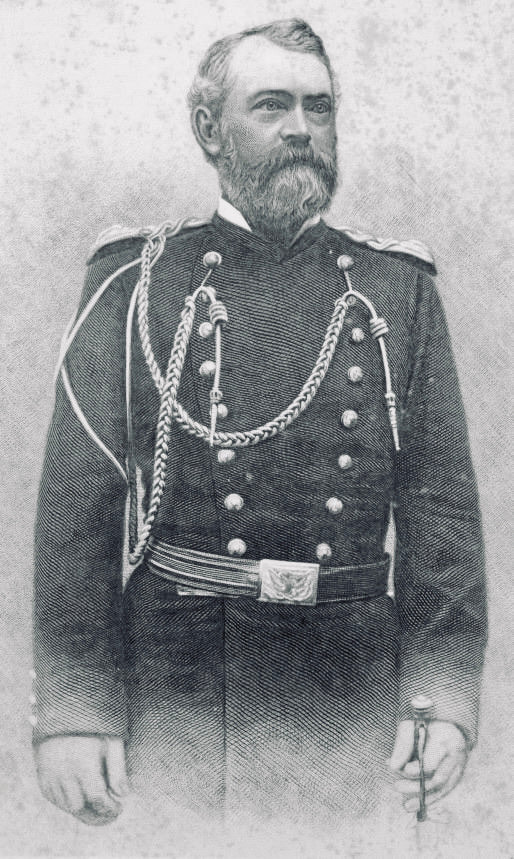
Richard Irving Dodge 1872
|
Richard Irving Dodge was born in North Carolina in 1837. His father, James R. Dodge, was from New York, while his mother, Susan Williams, was from North Carolina. On July 1, 1884, Richard Dodge started his military career as a West Point cadet. Four years after his graduation from West Point, he was promoted to Brevet, 2nd Lieutenant in the 8th U.S. Infantry. He then headed west, and for eleven years, he served at various frontier military posts in Texas from December 1848 to 1855. On March 3, 1855, Dodge was promoted to 1st Lieutenant on May 3, 1858, and transferred to West Point, where he served as an Assistant Instructor of Infantry Tactics until November 1, 1860.
After the Civil War broke out in April of 1861, Lt. Dodge was assigned at Fort Wood, NY. He elected to stay with the Union rather than resign his commission and fight for the Confederacy as many Southern-born officers did. |
On May 3, 1861, Dodge was promoted to Captain, 8th Infantry. He mainly held administrative posts related to recruiting and disbursement during the war, although he did participate in the First Battle of Bull run on June 1, 1861. He was promoted to Major of the 12th U.S. Infantry on June 21, 1864, and to Brevet Lt. Col. on March 30, 1865, for honorable and supportive services recruitment Armies of the United States.
Tales and Trials on the Kansas Plains: Richard Irving Dodge's Awe-Inspiring Buffalo Encounter and the Heated Conflicts of Fort Dodge
Venture back in time to the Kansas plains of 1872, a tumultuous period teeming with wild buffalo herds and intense military conflicts. This journey takes us through the eyes of Richard Irving Dodge, a soldier stationed at the heart of the wild west, at Fort Larnad.
Dodge recounts his encounters with massive buffalo herds, estimated to number in the hundreds of thousands, as they migrated north for the summer. These descriptions breathe life into the vast prairie, painting a vivid picture of the awe-inspiring sight and the incredible biodiversity that once graced the Kansas plains.
However, life on the plains was not all about coexisting peacefully with nature. The fiery confrontation between Captain Reif and Captain Moore at Fort Dodge serves as a stark reminder of the intense human drama that unfolded within the confines of these military forts. The episode delves into this altercation and the chaos that ensued, shedding light on the struggles of maintaining order among soldiers and the controversies surrounding alcohol consumption in the fort.
Further adding to the dramatic narrative is the incident involving a drunken Lieutenant Turner, whose unruly behaviour sparked chaos at the fort. The podcast navigates through these tumultuous events, providing a gripping account of the trials and tribulations faced by soldiers in these frontier forts.
The episode concludes with a look at the aftermath of these incidents, including the decision to establish a township near the fort. It explores the logistical and strategic implications of such a move, delving into the political machinations and decision-making processes of the time.
This narrative is not just a historical recounting; it's a testament to the trials, tribulations, and triumphs of those who lived through this challenging period. It offers a rare insight into the untamed life of soldiers stationed in the Kansas plains during the 1870s.
This episode promises a riveting journey into a past era marked by awe-inspiring natural spectacles, fierce personal conflicts, and the relentless struggle for order and discipline in a wild, untamed frontier. It's an unmissable experience for history buffs, offering a deep dive into a fascinating period of American history.
Join us on this incredible journey through time, as we delve into the tales and trials on the Kansas plains, revealing the awe-inspiring encounters and heated conflicts of Fort Larnad. It's a trip into the past that promises to leave you enlightened, entertained, and eagerly awaiting the next episode.
Dodge recounts his encounters with massive buffalo herds, estimated to number in the hundreds of thousands, as they migrated north for the summer. These descriptions breathe life into the vast prairie, painting a vivid picture of the awe-inspiring sight and the incredible biodiversity that once graced the Kansas plains.
However, life on the plains was not all about coexisting peacefully with nature. The fiery confrontation between Captain Reif and Captain Moore at Fort Dodge serves as a stark reminder of the intense human drama that unfolded within the confines of these military forts. The episode delves into this altercation and the chaos that ensued, shedding light on the struggles of maintaining order among soldiers and the controversies surrounding alcohol consumption in the fort.
Further adding to the dramatic narrative is the incident involving a drunken Lieutenant Turner, whose unruly behaviour sparked chaos at the fort. The podcast navigates through these tumultuous events, providing a gripping account of the trials and tribulations faced by soldiers in these frontier forts.
The episode concludes with a look at the aftermath of these incidents, including the decision to establish a township near the fort. It explores the logistical and strategic implications of such a move, delving into the political machinations and decision-making processes of the time.
This narrative is not just a historical recounting; it's a testament to the trials, tribulations, and triumphs of those who lived through this challenging period. It offers a rare insight into the untamed life of soldiers stationed in the Kansas plains during the 1870s.
This episode promises a riveting journey into a past era marked by awe-inspiring natural spectacles, fierce personal conflicts, and the relentless struggle for order and discipline in a wild, untamed frontier. It's an unmissable experience for history buffs, offering a deep dive into a fascinating period of American history.
Join us on this incredible journey through time, as we delve into the tales and trials on the Kansas plains, revealing the awe-inspiring encounters and heated conflicts of Fort Larnad. It's a trip into the past that promises to leave you enlightened, entertained, and eagerly awaiting the next episode.
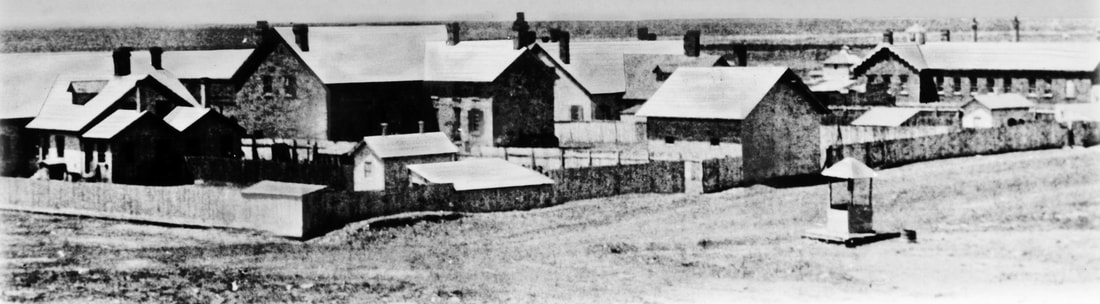
After Colonel Richard I. Dodge assumed command of Fort Dodge in the spring of 1872, he stopped the sale of alcohol at the fort. This order affected not only the soldiers but also the buffalo hunters and traders in western Kansas. The Atchison, Topeka & Santa Fe Railroad was laying track toward Fort Dodge, bringing hundreds of workers. George M. Hoover, a 24-year-old Canadian, jumped on this golden opportunity. He went to eastern Kansas and brought a wagonload of whiskey back to Fort Dodge. On June 17, 1872, Hoover, destined to become the richest man in Dodge City, measured off five miles to the west and opened for business, charging 25 cents a drink.
There Dodge chastised Lieutenant Turner and his soldiers about this severe breach of military etiquette. In response, the angry Lieutenant knocked Dodge to the floor. This was why Colonel Dodge banned the sale and distribution of alcohol to all enlisted and civilians at Fort Dodge. Soon after the incident, a site was selected five miles west of the Fort and a town company organized by Dodge and his officers.
To organize the town company Robert Wright the owner of the Sutler store, was elected president of the enterprise. Enterprising businessmen responded to this prohibition by setting up saloons and dance halls just outside the Fort Dodge military reservation boundaries - right where downtown Dodge City sits today. Stores and other businesses soon followed.
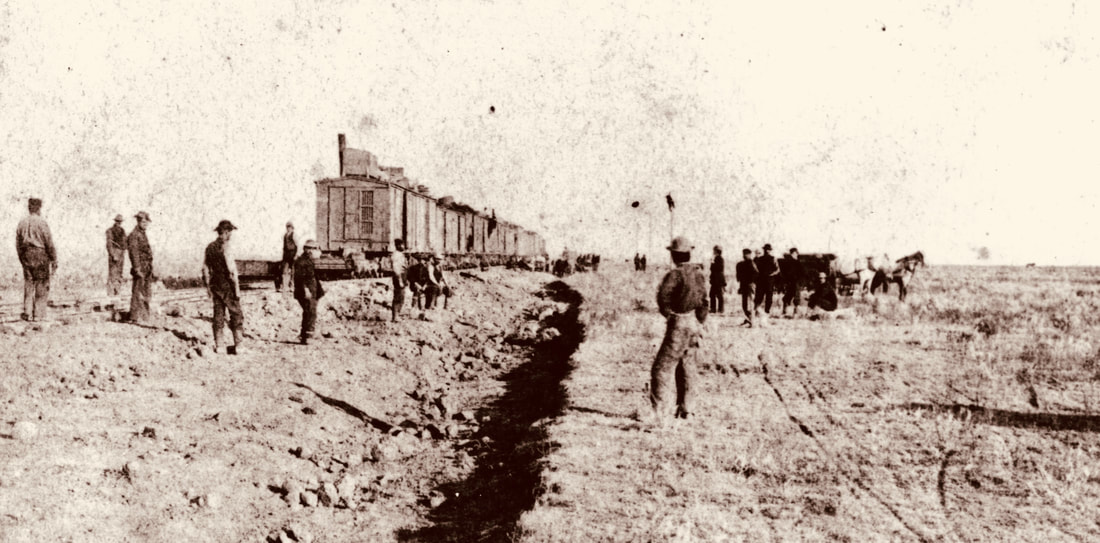
The arrival of the railroad in September, 1872 added to the surge of entrepreneurial activity. As can be expected, things got out of hand in the new city. Despite all the sensuality and violence, Richard Dodge got in on the act as a charter member of the Dodge City Town Company, encouraging many of the Fort's civilian managers to buy town lots.
To organize the town company Robert Wright the owner of the Sutler store, was elected president of the enterprise. Enterprising businessmen responded to this prohibition by setting up saloons and dance halls just outside the Fort Dodge military reservation boundaries - right where downtown Dodge City sits today. Stores and other businesses soon followed.
The arrival of the railroad in September, 1872 added to the surge of entrepreneurial activity. As can be expected, things got out of hand in the new city. Despite all the sensuality and violence, Richard Dodge got in on the act as a charter member of the Dodge City Town Company, encouraging many of the Fort's civilian managers to buy town lots.
Although Richard Dodge was not a merchant buffalo hunter himself, he was an avid hunter who, under the rank of Lieutenant Colonel, provided hunter access to the buffalo ranges south of the Arkansas River. His historical role as commander of Fort Dodge allowed him to see and experience the beginning and end of the Southern buffalo herds. As commander of the Fort, his duties expanded to the founding of Buffalo City, now Dodge City, as he regulated the Indian reservation South of Arkansas river – a territory given to the Indians at the medicine lodge treaty.
Dodge also participated in Sherman and Sheridan provisions of influential American citizens and foreigners with letters of introduction to western commanders. The letters enabled the influential individuals to obtain supplies, equipment, military escorts, knowledgeable scouts, and other types of assistance at frontier military posts. That accommodative policy allowed the army to advance its goal of exterminating the buffalo while gaining favor with the prominent and influential. Such hunting parties typically slaughtered buffalo and other wildlife with reckless abandon.
Dodge also participated in Sherman and Sheridan provisions of influential American citizens and foreigners with letters of introduction to western commanders. The letters enabled the influential individuals to obtain supplies, equipment, military escorts, knowledgeable scouts, and other types of assistance at frontier military posts. That accommodative policy allowed the army to advance its goal of exterminating the buffalo while gaining favor with the prominent and influential. Such hunting parties typically slaughtered buffalo and other wildlife with reckless abandon.
|
Dodge also participated in Sherman and Sheridan provisions of influential American citizens and foreigners with letters of introduction to western commanders. The letters enabled the influential individuals to obtain supplies, equipment, military escorts, knowledgeable scouts, and other types of assistance at frontier military posts. That accommodative policy allowed the army to advance its goal of exterminating the buffalo while gaining favor with the prominent and influential. Such hunting parties typically slaughtered buffalo and other wildlife with reckless abandon.
|
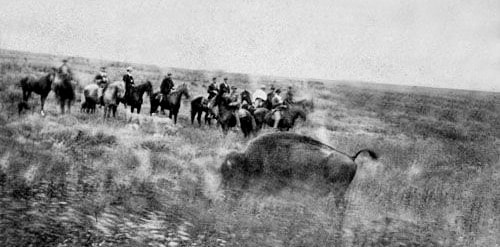
Lieutenant Colonel Richard Irving Dodge, who, like so many frontier officers, was an avid hunter, took three English gentlemen on a twenty-day hunt in Kansas in the fall of 1872. The Englishmen killed 127 buffalo in their excitement," more buffalo than would have supplied a brigade." The following year the same party killed a comparable number.
The Great Book of Buffalo Hunters Wild West Podcast
|
We begin our story along the Arkansas River Valley a location to the adjoining Santa Fe Trail, a military outpost located on a vast buffalo range of the future southern most point of the Santa Fe railroad line. Men of a speculative mind, not blind of this location found a land of commercial promise. This land of promise was located upstream, five miles west from the outpost on a vast empty landscape arrives a civilization in the form of a little settlement, soon to be known as Dodge City Kansas. Dodge City Kansas became a boomtown for making money - gambling was carried on extensively, and the saloons were full... mostly everyone in the town seemed bent on wantonness and indulgence accept for the good citizen. Join us now as we take you back in history to the southwest region of Kansas as we bring you the story of Richard Irving Dodge. (Click Here to Read The Great Book of Buffalo Hunters)
|
|