Gold & The Overland Trail
There had been reports of gold in the Rocky Mountains since the time of the Conquistadors. John Ralston had found a little in Arvada in 1849. But no one had gotten rich. William Green Russell and some other successful Georgia miners decided to come to the Rocky Mountains and find lots of gold. They left Georgia on February 17, 1858, and after four months on the road, they got to the banks of Cherry Creek on June 24. They came following the Santa Fe Trail to the Cherokee Trail. On July 3rd, most gave up and returned home. Thirteen remained. These people were convinced gold was here and were determined to find it. A few weeks later, James Pierce, Russell’s cousin, found about $400 worth of gold at the mouth of Little Dry Creek in Englewood. On the last day of July, a whisky trader and complete stranger, John Cantrell, a former California 49er himself, rode into the Dry Creek camp and not only visited for a week but, upon his departure to Kansas City, took a bag of Jim Pierce’s gold-bearing gravel and dirt with him. Arriving in Kansas City with his pouch of pay dirt, Cantrell had it assayed and the value attested. On August 26, the Kansas City Journal of Commerce headlines of August 26, 1858, stated: Gold in Kansas Territory!! The Pike's Peak Mines! First Arrival of Gold Dust at Kansas City!!!" Wild West Podcast proudly presents Gold & The Overland Trail, excerpts from Rush to the Rockies, 1859, by Anges Wright Spring.
The Butterfield Overland Dispatch 1865
The purpose of the Butterfield Overland Despatch (B.O.D.) was to control the bulk of the plains' vast traffic. The plan for the B.O.D. to transport merchandise and all kinds of freight from the Missouri River to Denver and other towns in Colorado. This plan also included a supply route to the rich mining camps being developed in the great Northwest territories.
David Butterfield
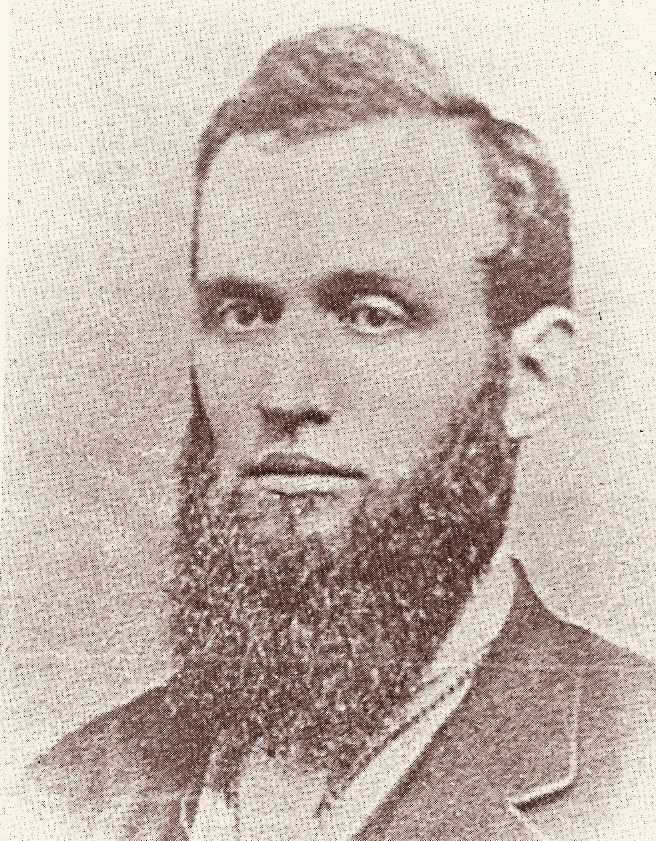
David Butterfield, an ambitious man, formed an extensive acquaintance in Denver and other Colorado towns and mining camps. He knew the vastness of the commerce of the plains. He wanted to be at the head of some great enterprise connected with the overland route. Butterfield was determined that an overland trail could be profitable. This prompted him to seek out financial backing from investors in the East. On June 4, 1865, the smooth-talking businessman, David Butterfield, obtained capital for the "Butterfield Overland Dispatch" for 3 million dollars.
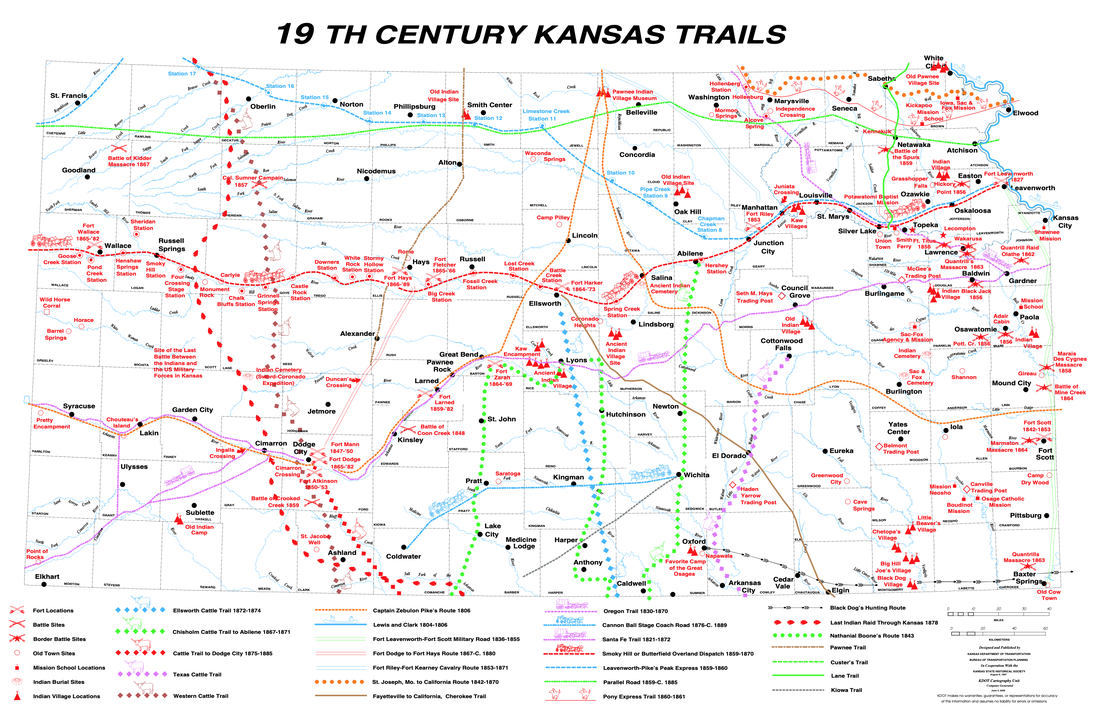
Butterfield saw how much freight was going overland to Denver and the mining districts. He studied the Overland Trail survey maps as laid out in 1860. The Overland Trail extended west from Atchison, Kansas on the Missouri River to Denver, spanning the length of Kansas. The trail was named after the Smoky Hill River whose course paralleled for much of the rivers length. The Overland trail became Smoky Hill Road, which followed an ancient Indian trail, was the fastest path to the goldfields. The road used by prospectors became the most direct route west to Colorado during the Pike's Peak Gold Rush. Butterfield decided much of this road could be used, for freight services but his road had to be shorter, safer, and faster.
Butterfield saw how much freight was going overland to Denver and the mining districts. He studied the Overland Trail survey maps as laid out in 1860. The Overland Trail extended west from Atchison, Kansas on the Missouri River to Denver, spanning the length of Kansas. The trail was named after the Smoky Hill River whose course paralleled for much of the rivers length. The Overland trail became Smoky Hill Road, which followed an ancient Indian trail, was the fastest path to the goldfields. The road used by prospectors became the most direct route west to Colorado during the Pike's Peak Gold Rush. Butterfield decided much of this road could be used, for freight services but his road had to be shorter, safer, and faster.
The route up the Kansas River and Smoky Hill fork was the one he had marked out because it was practically a straight line from Atchison to Denver; it was known that it would save at least fifty miles in distance. Previous stage lines had not been successful due to a scarcity of water and frequent Indian attacks.
In the latter part of June, 1864, David Butterfield left Denver and took up his residence in Atchison, Kansas. In the 1860’s Atchison, was one of the most prosperous towns on the Missouri River. During that time, there were no railroads on Kansas soil, and steamboats on the “Big Muddy" did most of the freight transportation from St. Louis to Kansas.
In the latter part of June, 1864, David Butterfield left Denver and took up his residence in Atchison, Kansas. In the 1860’s Atchison, was one of the most prosperous towns on the Missouri River. During that time, there were no railroads on Kansas soil, and steamboats on the “Big Muddy" did most of the freight transportation from St. Louis to Kansas.
Passenger Express Stage Line 1865
During the summer of 1865, the route was equipped for a tri-weekly passenger and express stage line. He purchased twenty good coaches bought in Chicago. At the cost of 175.00 per person, the first stage to leave Atchison by this route reached Denver on September 23, 1865. The route extended for 585 miles from Leavenworth and Atchison to Denver and the Smoky Hill River. Relay stations were built about every twelve miles. These relay stations provided passengers with rest, food, and the changing of horses. The first line was a success, providing tri-weekly express service lasting from 8 to 12 days.
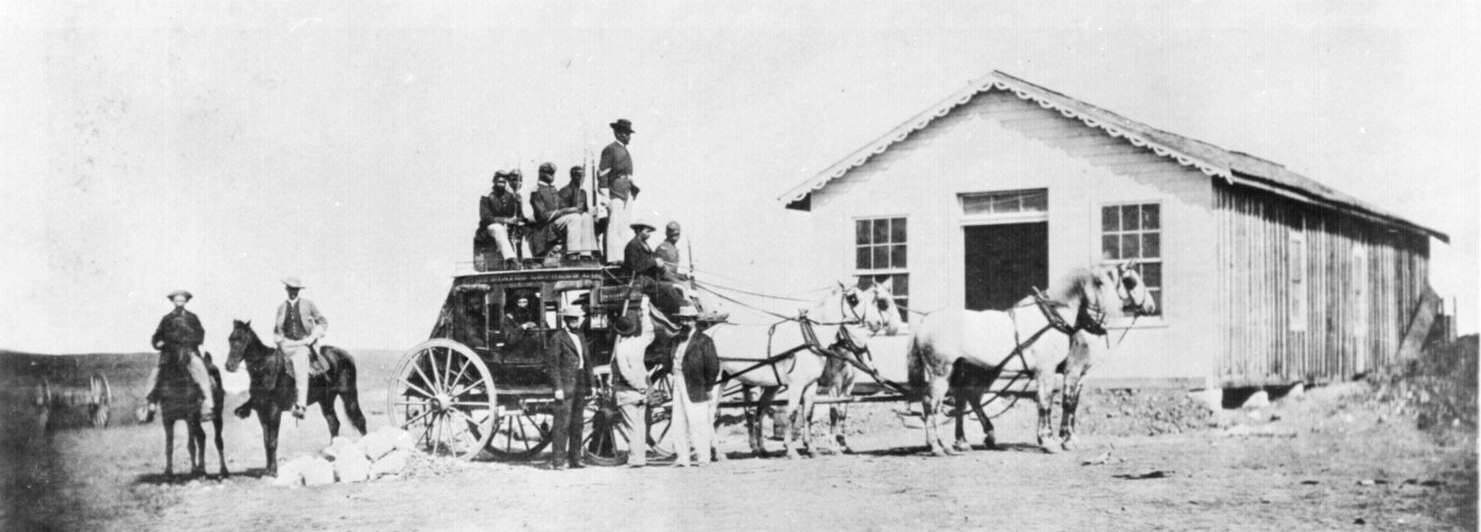
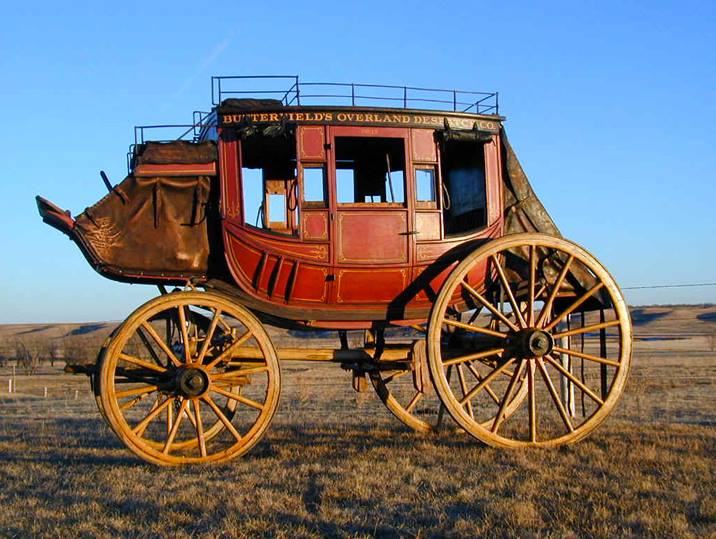
A common name for the coach used on the Overland Mail was made by Abbott-Downing Company, Concord, New Hampshire. The coach had an arching roof with a railing around the outer edge. The front was the boot where the driver sat with his feet braced against the footboard. Behind his feet were a sack of tools, a treasure box, a water bucket, a buffalo robe, and perhaps some mail. At the rear was another boot, a sort of projecting platform covered with a leather curtain. The rear platform was used to carry the baggage, express, and mail. Any over-flow of packages or mail was carried on top of the coach and also protected the passengers from rain and cold wind. This coach was the best of its type when new it cost from $1,000 to $1,500. |
|
Burden of Protection
The B.O.D. became an additional burden of protection put upon the shoulders of the military authorities in Kansas. A chain of forts and outposts was constructed along the Smoky Hill Valley by the Government to give the route adequate defense. Soldiers were also posted along the pathway at Fort Downer, Fort Harker, Fort Monument, Fort Wallace, and other stops to protect the stations and the travelers from Indian attacks. The soldiers could not keep up with the furious Indians who felt their land was being invaded.
Indian Fights
One of the most prominent Indian fights along the Butterfield Trail came on October 2, 1865. This was when some 30 Cheyenne warriors attacked a lone stage near Monument Station. The passengers fought for some time but finally had to abandon the coach, taking horses and starting east. The Indians plundered and burned the coach, burned the station house, and drove off mules. Before the year was ended, General G. M. Dodge Placed troops on the road west of Fort Ellsworth at Big Creek, Monument nation, and Pond’s Creek.
Holladay Overland Mail Express Company 1867
|
Butterfield suffered financial difficulties from the Indian depredations, and the great enterprise was forced to succumb to Ben Holladay. In 1867 the two lines were consolidated, and the name accordingly changed to the “Holladay Overland Mail and Express Company." Butterfield lost about a million dollars and sold out almost precisely eighteen months after starting the B.O.D. He moved to Mississippi, then to Arkansas, where he was fatally shot on March 28, 1875.
The Overland Mail and Express Company continued until the iron bands were spiked down, in the spring of 1869. This was when the transcontinental railroad line was completed on May 10, 1869, at Promontory Point, Utah. A Golden Spike driving ceremony was held at the location where the two lines met, one coming from the East and the other coming from the West.
|
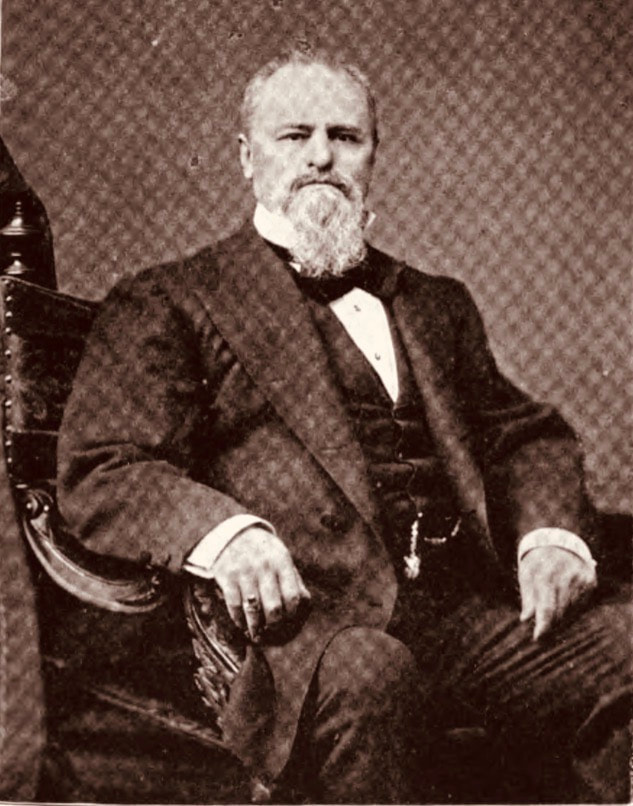
Ben Holladay
|