The Founding of Dodge City: Episode 1: Gateway to the Southwest
Situated at the exact point that once divided Spain and France's claims in the New World, the future site of Dodge City was rich with possibilities. Watered by the mighty Arkansas River and fed by a vast grassland, the area was home to millions of Bison that provided resources to the Plains Tribes. The presentation includes photos, videos, and podcast sound bites of the following historical accounts of the Founding of Dodge City.
|
|
Gateway to the SouthwestIn Episode 1, Gateway to the Southwest, Brad Smalley & Mike King provides the historical accounts of the first travelers along the Arkansas River Valley, from the Coronado Expedition of 1541 to the founding of the Santa Fe Trail in 1821 to the establishments of the first military forts (Mann 1847 and Atkinson 1850) to protect commerce along the trails at the Cimarron crossing. The presentation concludes with information concerning the preservation of Fort Dodge.
|
FORT MANN 1846 (GPS: N37 45.142 W100 04.596)
|
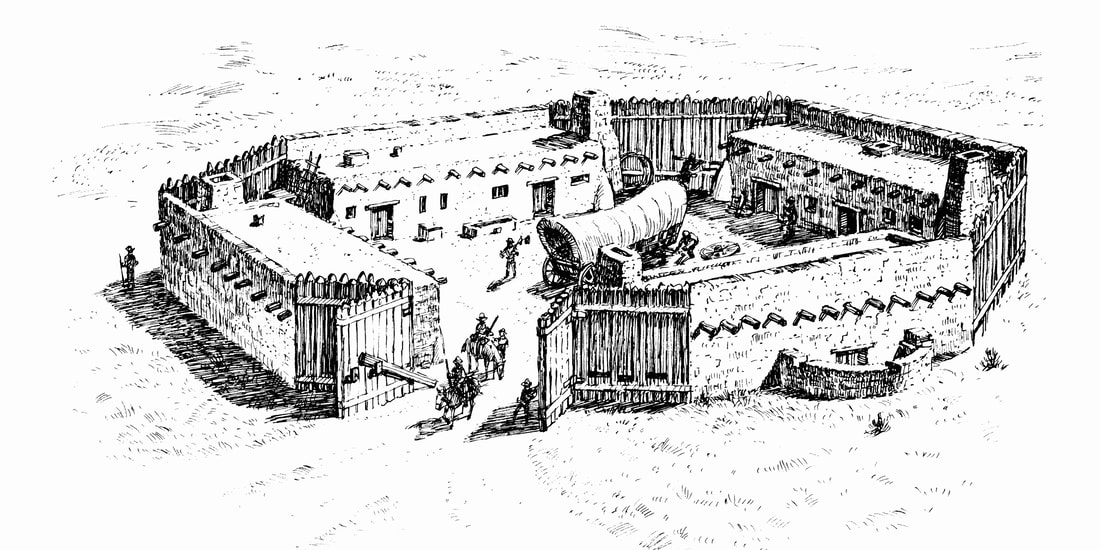
Fort Mann, established in 1846 as a quartermaster's station rather than a troop base, was used by some volunteer troops during 1847-1848. In April 1847, forty teamsters under Capt. Daniel P. Mann, a master teamster, began construction of the post. The post was named Fort Mann, after him. By late May, construction was completed. The fort consisted of four flat-roofed buildings laid out in a rectangle with a large courtyard at the center. The buildings were positioned, so the stockade wall on the opposite side of the gate was on the north side of the fort.
|
The buildings, constructed of wood and adobe, were connected by four sections of wooden stockade walls at angles, giving the post an octagonal shape. At the center of one of the stockade walls was a gate one foot thick. The gate opened at its center. Loopholes were cut into the stockade walls to allow those inside to shoot outside in case of an attack. A six-pounder cannon, sometimes called a mountain howitzer, was mounted on wheels. Adobe breastworks were built on the roof of both the northwest building and the southeast building.
In response to the growing frequency of Indian attacks, Fort Mann, in reality, a way station, was established near an unsafe point of the Cimarron in 1845. Nevertheless, the military significance of the post was considered modest. The fortifications of the post consisted of nothing more than four log houses set in a square and connected by log walls twenty feet high and sixty feet long. Thus, the log houses of Fort Mann could garrison only a small detachment of troops. However, travelers along the route welcomed the opportunity to rest, repair their equipment, and trade tired or disabled draft animals for rested stock previously exchanged by an earlier train without the threat of attack on the open prairie.
The volume of goods passing Fort Mann increased dramatically during the Mexican War as the military wrestled with the problem of supplying large armies in the field over several thousand miles of challenging terrain. Finally, during 1848, the War with Mexico ended. The sharp reduction in government trains that accompanied peace led to Fort Mann's abandonment in 1850, when a new post, Fort Atkinson, was established six miles downstream.
The volume of goods passing Fort Mann increased dramatically during the Mexican War as the military wrestled with the problem of supplying large armies in the field over several thousand miles of challenging terrain. Finally, during 1848, the War with Mexico ended. The sharp reduction in government trains that accompanied peace led to Fort Mann's abandonment in 1850, when a new post, Fort Atkinson, was established six miles downstream.

| gilpins_volunteers_on_the_santa_fe_trail.pdf |
Untold Tales of the Santa Fe Trail: A Dive into the Historic Forts of the Wild West and the Untold Story of Fort Dodge
The Santa Fe Trail holds a significant place in American history as a key route for westward expansion and trade during the 19th century. In this podcast episode, we embark on a journey back in time to explore the untold stories of the historic forts that guarded the Santa Fe Trail. Forts Mann, Atkinson, and Dodge played vital roles in securing the frontier and facilitating the flourishing commercial frontier. However, while the stories of Forts Mann and Atkinson have been acknowledged to some extent, the true importance of Fort Dodge has been largely overlooked.
The episode begins by providing a comprehensive overview of the forts along the Arkansas River Valley, starting with Fort Mann, established in 1846, and Fort Atkinson, established in 1850. These forts were part of a series of outposts that made the settlement of the West possible. They provided protection for the wagon trains carrying goods along the Santa Fe Trail, which stretched and spanned the prairies of Kansas by 1821. The military had to ensure the safety of these commercial endeavors, which often faced attacks from malicious marauders. The forts served as strategic points along the trail, offering rest, repairs, and trade opportunities for weary travelers. Despite their historical significance, Fort Dodge has been left behind in the historic preservation movement, and its true importance has never been thoroughly evaluated.
To shed light on the untold stories of Fort Dodge, the podcast episode features an expert guest, Deb Goodrich. Goodrich captivates listeners with tales from the Battle of Solomon Fork and insights into the intriguing life of Jeb Stewart, who was immortalized by Errol Flynn in the movie Santa Fe Trail. Goodrich's intimate knowledge of the place where Jeb Stewart grew up adds a personal touch to the historical narratives. The episode also highlights significant upcoming events, such as the 200th anniversary of the Santa Fe Trail and the planned docudrama project, Contested Plains, which tells the story of the German family massacre in 1874. Award-winning filmmaker Ken Spurgeon's involvement in the project adds excitement and anticipation for the upcoming release.
Preserving history is a crucial endeavor that allows us to connect with our past and understand the events and people that shaped our present. The preservation of Fort Dodge and other historical sites is vital to ensuring that future generations can experience and learn from the stories of the past. Fort Dodge, in particular, holds immense historical value as a significant frontier fort involved in major campaigns to eliminate Indian depredations on the plains. The fort's contributions to the American westward expansion and the commercial frontier should not be overshadowed or forgotten.
The podcast episode also touches on the importance of telling the stories of soldiers and their sacrifices. Kansas, once known as the "soldier state," has a rich military history that deserves to be preserved and shared. By preserving the stories of these soldiers, we honor their service and gain a deeper understanding of the challenges they faced. The episode emphasizes the need to continue telling these stories and ensuring that the sacrifices of soldiers, both past and present, are not forgotten.
In conclusion, this podcast episode takes listeners on a captivating journey through the untold stories of the Santa Fe Trail forts. From Forts Mann and Atkinson to the overlooked significance of Fort Dodge, we uncover the hushed histories of the Old West and shed light on the forgotten legacies of these forts. The episode highlights the importance of preserving history and the need to continue telling the stories of soldiers and their contributions to the American frontier. As we traverse the annals of American military history, we gain a deeper appreciation for the untold narratives of the early forts along the Arkansas River.
The episode begins by providing a comprehensive overview of the forts along the Arkansas River Valley, starting with Fort Mann, established in 1846, and Fort Atkinson, established in 1850. These forts were part of a series of outposts that made the settlement of the West possible. They provided protection for the wagon trains carrying goods along the Santa Fe Trail, which stretched and spanned the prairies of Kansas by 1821. The military had to ensure the safety of these commercial endeavors, which often faced attacks from malicious marauders. The forts served as strategic points along the trail, offering rest, repairs, and trade opportunities for weary travelers. Despite their historical significance, Fort Dodge has been left behind in the historic preservation movement, and its true importance has never been thoroughly evaluated.
To shed light on the untold stories of Fort Dodge, the podcast episode features an expert guest, Deb Goodrich. Goodrich captivates listeners with tales from the Battle of Solomon Fork and insights into the intriguing life of Jeb Stewart, who was immortalized by Errol Flynn in the movie Santa Fe Trail. Goodrich's intimate knowledge of the place where Jeb Stewart grew up adds a personal touch to the historical narratives. The episode also highlights significant upcoming events, such as the 200th anniversary of the Santa Fe Trail and the planned docudrama project, Contested Plains, which tells the story of the German family massacre in 1874. Award-winning filmmaker Ken Spurgeon's involvement in the project adds excitement and anticipation for the upcoming release.
Preserving history is a crucial endeavor that allows us to connect with our past and understand the events and people that shaped our present. The preservation of Fort Dodge and other historical sites is vital to ensuring that future generations can experience and learn from the stories of the past. Fort Dodge, in particular, holds immense historical value as a significant frontier fort involved in major campaigns to eliminate Indian depredations on the plains. The fort's contributions to the American westward expansion and the commercial frontier should not be overshadowed or forgotten.
The podcast episode also touches on the importance of telling the stories of soldiers and their sacrifices. Kansas, once known as the "soldier state," has a rich military history that deserves to be preserved and shared. By preserving the stories of these soldiers, we honor their service and gain a deeper understanding of the challenges they faced. The episode emphasizes the need to continue telling these stories and ensuring that the sacrifices of soldiers, both past and present, are not forgotten.
In conclusion, this podcast episode takes listeners on a captivating journey through the untold stories of the Santa Fe Trail forts. From Forts Mann and Atkinson to the overlooked significance of Fort Dodge, we uncover the hushed histories of the Old West and shed light on the forgotten legacies of these forts. The episode highlights the importance of preserving history and the need to continue telling the stories of soldiers and their contributions to the American frontier. As we traverse the annals of American military history, we gain a deeper appreciation for the untold narratives of the early forts along the Arkansas River.
FORT ATKINSON 1850 (GPS: N37 45.150 W100 04.974)
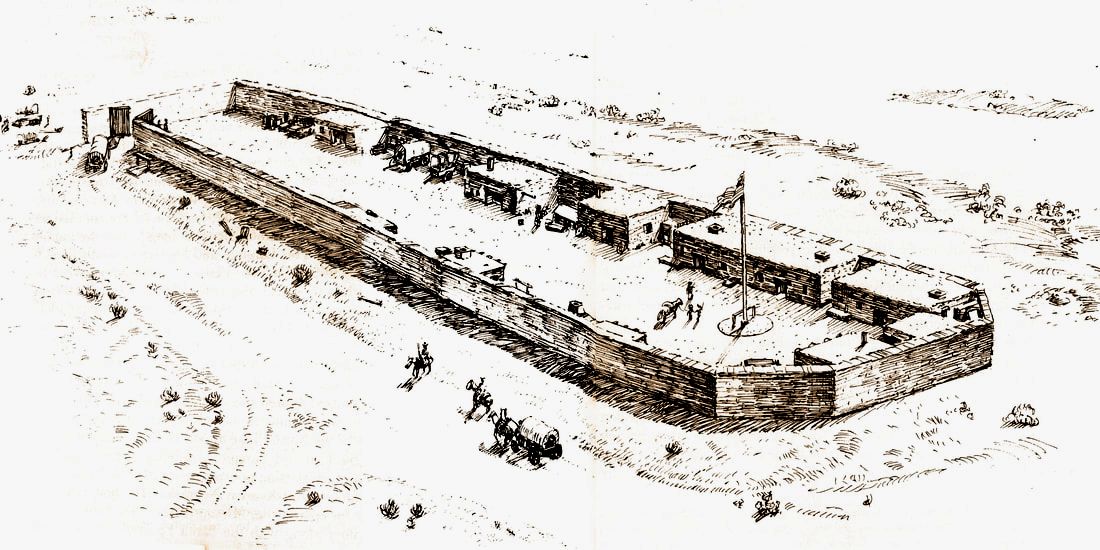
The original Fort Atkinson was established on August 8, 1850, by the U.S. Army to prevent Indians in the area from attacking travelers on the Santa Fe Trail. Even before this, a site nearby was occupied in July 1850 by Lieut. Col. Edwin Vose Sumner. Fort Atkinson, 1850-1854, was the first regular army post on the Santa Fe trail in the heart of the Indian country, located some 6 or 8 miles up the river from Dodge City.
Camp Mackay was established near the Middle Crossing of the Arkansas River. On September 12, 1850, the soldiers at Camp Mackay moved to the new post on the Arkansas River, known until June of 1851 when it was named Fort Atkinson. The fort was built of sod, covered with poles, brush, sod, and canvas. The post measured 150' on the north side, 355' on the east and west sides, and 60' on the south side. The officer quarters were along the north wall, and the enlisted barracks were along the west wall. The soldiers quartered there gave it the name of Fort Sod, and later Fort Sodom. It was known as Camp Mackay until June 25, 1851, when the name was changed to Fort Atkinson.
Camp Mackay was established near the Middle Crossing of the Arkansas River. On September 12, 1850, the soldiers at Camp Mackay moved to the new post on the Arkansas River, known until June of 1851 when it was named Fort Atkinson. The fort was built of sod, covered with poles, brush, sod, and canvas. The post measured 150' on the north side, 355' on the east and west sides, and 60' on the south side. The officer quarters were along the north wall, and the enlisted barracks were along the west wall. The soldiers quartered there gave it the name of Fort Sod, and later Fort Sodom. It was known as Camp Mackay until June 25, 1851, when the name was changed to Fort Atkinson.
Unlike Fort Mann, which had served the needs of public and commercial trains to a much greater extent than chastizing marauding Indians, Fort Atkinson was designed to function primarily as a traditional military installation. Yet, the life of this new post was short. The recurrence of Indian attacks on the Santa Fe Trail travelers declined sharply during the following years, and Fort Atkinson was abandoned in 1853.