Summer of 1866
During the summer of 1866, the first shipments of lumber arrived from military depots in eastern Kansas. The nearest plentiful source of timber was approximately twelve miles from the fort. The trees in these groves were of inferior quality. The lumber could only be used for making corral fences and firewood. Officers' quarters and a temporary hospital were erected from sod and roofed with earth. Many men first stationed at Fort Dodge were Confederate soldiers who preferred a fight with the Indians to languishing, perhaps dying, in northern prisons.
The heavy seasonal rains of late spring and summer quickly weakened all of the sod buildings, thereby appreciably dampening the enthusiasm of the garrison for continuing construction with that material.
The sod found near the post was of poor quality, and continual soaking led to sagging walls and caved-in roofs. As the first civilian employees arrived to join the soldiers in erecting new structures, their laborers were directed to constructing badly needed storehouses and a corral for fifty horses. A good portion of the quartermaster supplies was lost the first year through exposure to the elements.
During this time, the roofs of the dugouts were elevated, and wooden bunks were constructed from the lumber provided by the first supply train. In addition, old tents were used to line the tops of the dwellings to ward off inclement weather.
The heavy seasonal rains of late spring and summer quickly weakened all of the sod buildings, thereby appreciably dampening the enthusiasm of the garrison for continuing construction with that material.
The sod found near the post was of poor quality, and continual soaking led to sagging walls and caved-in roofs. As the first civilian employees arrived to join the soldiers in erecting new structures, their laborers were directed to constructing badly needed storehouses and a corral for fifty horses. A good portion of the quartermaster supplies was lost the first year through exposure to the elements.
During this time, the roofs of the dugouts were elevated, and wooden bunks were constructed from the lumber provided by the first supply train. In addition, old tents were used to line the tops of the dwellings to ward off inclement weather.
First Sutler Store
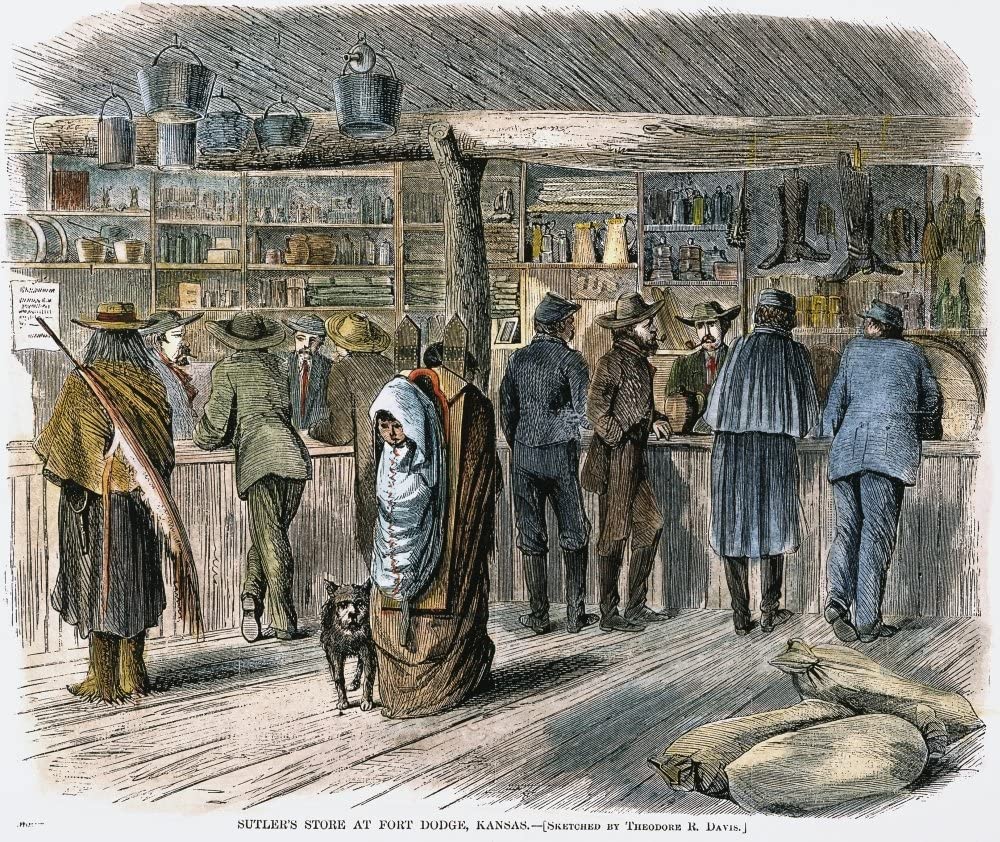
The sketch shows flat-bottom kettles of various sizes hanging from the ceiling and a wide array of merchandise on the shelves. Military men of multiple ranks stand at the counter along with an Indian man wearing a gun and holster and an Indian woman with a baby in a cradleboard standing a few feet away. The drawing shows a wooden floor, which would have been unusually expensive at the time.
|
The lack of diversion experienced by the garrison during the winter of 1865 was not easily forgotten. Instead, the troops at the garrison banded together the following spring as a volunteer labor force during their spare time to build a sutler's store, which their commander referred to as a small miserable sod building.
By early summer, a sutler, William Ladd, had been appointed; but the troops' greetings were short-lived. The merchandise sold by Ladd was supplied by his partner, Theodore Weichselbaum, who had secured a contract to operate several stores on military posts west of Fort Leavenworth. Their store at Fort Dodge provided a surprising list of goods to the soldiers: foods, cooking utensils, dishes, sewing supplies, building materials, clothing, guns and ammunition, liquor, horse supplies, pencils and paper, and playing cards. In August, the young commander of Fort Dodge, Captain Andrew Sheridan, reprimanded Ladd for charging the soldiers excessively for purchases made and ordered him to reduce his prices. In addition, a Post Council of Administration was organized to oversee the sutler's store and any other civilian enterprises that might be undertaken near the fort in the immediate future. |
Desertion and Discipline
|
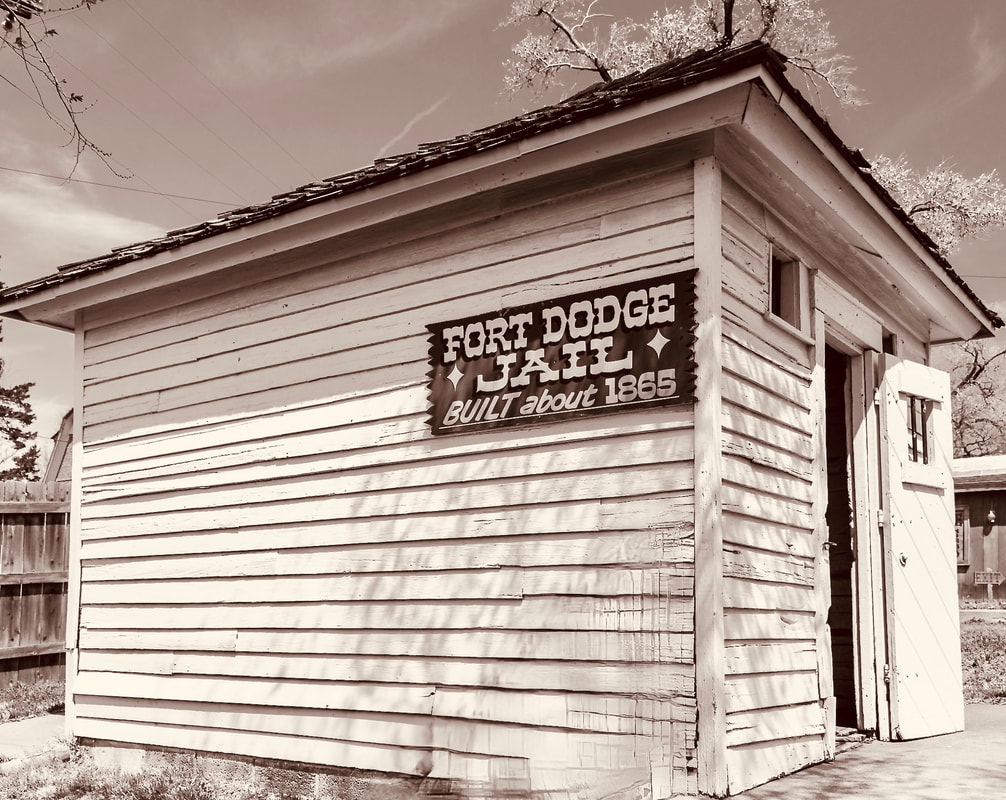
A small frame guardhouse was constructed to restrain wayward soldiers and civilians, but justice was administered rather slowly. Several months often elapsed before the officers of the post could spare the time to convene court-martial hearings.
Occasionally lesser offenders were released without standing before a court-martial hearing because the length of their pre-trial confinement was considered just disciplinary exaction for their crime. In addition, the presence of growing numbers of civilian artisans and laborers eroded military discipline. Fort Dodge Jail located at Boot Hill Museum was built in 1866
|
Sanitary Conditions
The foul conditions of civilian dugouts so irritated the post commander that he ordered their quarters purged with disinfectant. He predicted that an epidemic of disease would be visited on the entire post if they did not become mote sanitary in their living habits. As a result, pneumonia, dysentery, diarrhea, and malaria were common in the first year in the isolated fort.
Military Reservation
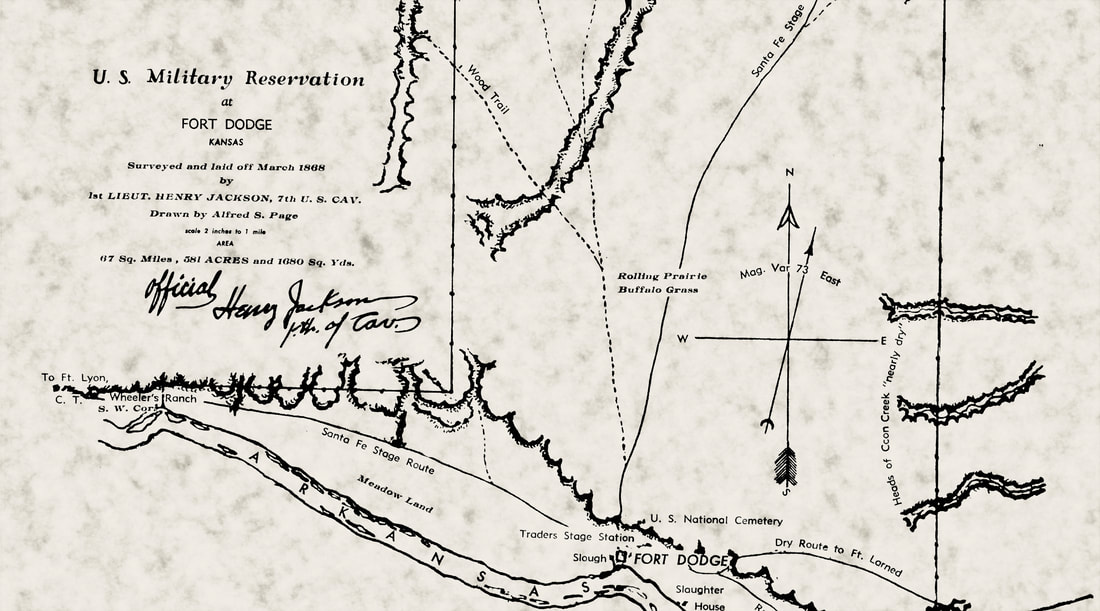
When orders were received in the spring of 1866 to establish a military reservation around the fort, survey parties were sent out to ascertain the location of the most advantageous terrain that might be included. It was decided that it would be necessary to establish the northern boundary of the reservation approximately fourteen miles above the post so that adequate reserves of stone, timber, and grass could be held for the future use of the garrison. The western boundary commenced at the one-hundredth meridian and extended more than five miles eastward at the widest point. Slightly more than forty-three thousand acres were included in the reservation.
Whiskey Ranches
|
Many of the first ranches established in the vicinity of the post during the formative years proved to be frequent sources of trouble for the garrison. These enterprises were referred to as "whiskey ranches' by the military, thereby reflecting the intentions of their proprietors. The Indian tribes along the Arkansas River tolerated these 'ranches' because they served as a primary source of liquor, guns, and ammunition. An astute owner of such an undertaking could expect as much as twenty to one return on his investments when his trade goods were exchanged for horses, buffalo robes, or annuity currency that had been given out to the Indians by government reservation agents.
The public trains which frequently passed by the fort proved to be a severe problem for the garrison's officers. Enterprising wagon hands were well aware of the lucrative market for whiskey that could be found among the troops and civilians on the post, and gallons of the forbidden spirits were smuggled onto the post despite the rigorous inspections that the post's officers carried out. The officers at Fort Dodge considered the Bureau of Indian |
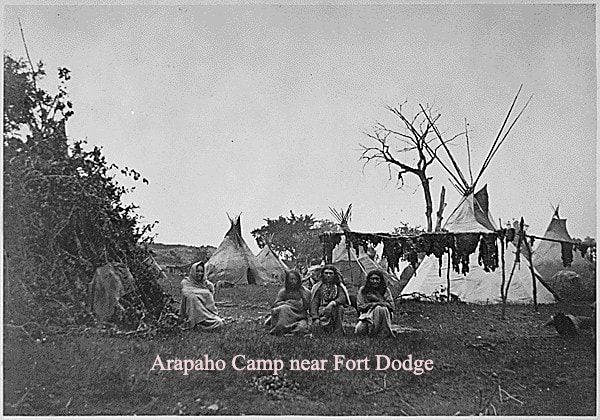
Affairs to be directly at fault for the sale of contraband whiskey and arms on the plains. The command complained bitterly to General Hancock, commander of the Department of the Missouri after the transfer of General Dodge in January 1866, that Indians frequently arrived at the fort to collect their annuities armed with newly purchased revolvers. In addition, some of the more prosperous tribesmen had obtained several handguns, which they valued over rifles because of their ease of handling while on horseback.
|