LEGENDS OF DODGE CITY
  • Home
    • Menu >
      • Books >
        • Dime Novel
        • Buffalo Days
        • Indian Wars
        • Man in a Black Derby Hat
        • Return of the Great Hunters
        • Luke McGlue
        • Free Audio Book
      • Wild West Podcast
      • Boot Hill Museum
      • Boot Hill Gunfighters' >
        • How to Become A Gunfighter
        • Roles
        • Scenario
        • Reenactments
        • Fights
        • Big Gunfight
    • Whiskey & Westerns on Wednesdays
    • Gunsmoke
  • Fort Dodge
    • Fort Dodge Buildings
    • Fort Dodge History >
      • Fort Dodge 1865
      • Fort Dodge 1866
      • Permanent Post 1867
      • Henry Douglas 1867
      • Richard Irving Dodge 1872
  • Dodge City
    • Saloons & Varieties
    • Time Line
    • Buffalo Days >
      • Adobe Walls >
        • William Bill Tilghman
        • Billy Dixon
        • Dave Morrow
        • Tom Nixon
        • Charles Rath
        • HooDoo Brown Story
        • Emanuel Dubbs Story
    • Cattle Drives >
      • Cattle Town
      • Gambling
      • Scarlet Ladies
    • Dodge City War
    • Soule Canal
    • Bull Fight of 1884
    • Rodeo History
    • Legends >
      • Wild Bill Hickok
      • Charles Bassett
      • James Masterson
      • Ham Bell
      • Bat Masterson
      • Chief Spotted Tail
      • George M. Hoover
      • Chalkley Beeson
      • Ormond W. Wright
      • Dora Hand
      • Webster
      • Luke McGlue
      • Ed Masterson
    • Saloon War
    • Mexican Village
  • Indian Wars
    • Cheyenne
    • Battle Solomon Fork
    • Hancocks' War 1867
    • Beecher Island
    • Medicine Lodge 1867
    • California Joe
    • Trails to the Washita
    • Cheyenne Exodus
  • Kansas History
    • Santa Fe Trail
    • Overland Trail
    • Forts Mann & Atkinson
    • Civil War
    • Black Sunday
    • Outlaws >
      • Vigilantes
      • Famous Gunfights >
        • Battle of Cimarron
      • Guns of the West
      • Dave Mathers
      • William L Brooks
      • Texas Billy Thompson
  • Blog

ED MASTERSON

Birth and Family Origins

Edward John Masterson was born on September 22, 1852, in Henryville, Canada East, which is now part of Quebec. Henryville is situated in the Montérégie region, where Thomas Masterson and Catherine McGurk welcomed their first child. The Masterson family was of Irish descent. While September 22 is widely recognized as his birth date, a baptismal record from Henryville, dated September 24, 1852, notes that the child was "né hier" (born yesterday), suggesting a possible birth date of September 23. This minor variation underscores the potential inconsistencies in historical records due to clerical practices or transcription errors of the time.
Edward was the eldest of seven children. His siblings included Bartholomew William Barclay ("Bat"), born in 1853; James Patrick, born in 1855; Nellie E., born in 1857, Thomas born in 1858; George Henry, born in 1860; and Emma Anna "Minnie," born in 1862. Several of his siblings, particularly Bat and James, later became notable figures in the history of the American West.
It is crucial to differentiate Edward John Masterson, the well-known lawman from Dodge City, from others with similar names in historical records. For instance, there was an Internal Revenue Service agent named Edward J. Masterson who married Florence Dalton in 1893, and an Edward J. Masterson Jr. born in Philadelphia in 1921. These individuals are from different times and contexts and are not related to the subject of this account.

Early Life and Westward Migration

The journey of the Masterson family echoed the experiences of countless others who ventured to search for new opportunities in 19th-century America. Originating from Canada East, they bravely relocated in the early 1850s, journeying through the bustling landscapes of New York and the expansive fields of Illinois before finally setting their sights on the promising frontier. By around 1871, they established their roots on an 80-acre farm near the burgeoning town of Wichita, Kansas. Edward, the youngest of the family, spent his formative years amidst the rich tapestry of rural life, enveloped by the rhythms of the agricultural world that defined the American Midwest and the expansive Plains during this vibrant period. The sound of rustling crops, the sight of plowed fields stretching to the horizon, and the camaraderie of family farming forged his character against the backdrop of 19th-century America’s relentless push toward a brighter future.

Transition to the Frontier: Early Occupations

As the Masterson brothers approached young adulthood, the siren call of the untamed frontier grew ever louder, eclipsing the more familiar, yet mundane, lure of farming. In the vibrant years of the early 1870s, Ed—then on the cusp of adulthood at nineteen or twenty—and his spirited younger brothers, Bat and Jim, abandoned the comforts of their family farm near Wichita. They searched for adventure and fortune across the sweeping vistas of the Great Plains, where the spirit of opportunity beckoned.
Their first foray into this wild expanse led them into the perilous realm of buffalo hunting. This demanding and hazardous profession tested their marksmanship and mettle against the elements. Driven by the promise of profit in a time when the great herds still roamed the prairie, the brothers embarked on treacherous hunts, where each day presented an unpredictable dance with nature and fate. Many accounts recount their burgeoning prosperity during these early hunts as they navigated a landscape alive with both danger and possibility. Among the vast, grassy plains, they brushed shoulders with legendary figures who would leave indelible marks on the history of the West, including the notorious Wyatt S. Earp and the skilled Buffalo hunter Billy Dixon. With his keen eye and steady hand, Bat earned a well-deserved reputation as a master marksman, reflecting the harsh realities and fierce competitiveness of frontier life.
In addition to their hunting exploits, Ed and Bat seized opportunities that directly contributed to the monumental westward expansion of America's infrastructure. In July 1872, they found themselves under the employ of a subcontractor named Raymond Ritter, tasked with grading a five-mile stretch of track for the relentless advance of the Atchison, Topeka & Santa Fe Railroad. Working under the blazing sun and the open sky, they were at the frontier of progress, physically shaping the burgeoning landscape of railroads connecting the nation. However, the pursuit of opportunity was not without its perils; when Ritter fled the scene without fully compensating them for their labor, a fiery confrontation ensued. Embodying the fierce independence of the frontier spirit, Bat Masterson tracked Ritter down, demanding the hard-earned wages at gunpoint—a testament to the rough-and-tumble nature of enterprise in such unregulated territories, where one often had to be their own arbiter of justice.
These formative experiences—the unyielding labor of railroad construction, the lethal thrill of buffalo hunting, encounters with a myriad of colorful frontier personalities, and the essential cultivation of self-reliance—indubitably sculpted the characters of the Masterson brothers. With each hardship endured, they refined their physical toughness and resourcefulness, developing a profound familiarity with firearms within the often merciless expanse of the plains. The bonds forged through these shared trials solidified their fraternal ties, equipping them with a practical education in survival and adaptability. This foundation would prove invaluable as they transitioned into law enforcement roles in one of the West's most tumultuous towns, ready to navigate the challenges ahead.
Picture
ORDER BOOK
"Edward Masterson and the Texas Cowboys," penned by Michael King, takes readers on an exhilarating ride through the American West, focusing on the lively and gritty cattle town of Dodge City, Kansas. This thrilling dime novel plunges into the action-packed year of Ed Masterson's life as a lawman, set against the backdrop of the chaotic cattle trade, filled with fierce conflicts, shifting loyalties, and rampant lawlessness. You can order the book on Amazon. https://www.amazon.com/dp/B0F8NW3K2N
Often eclipsed by his more famous brother, Bat Masterson, Edward carved out his own legacy of bravery and an unwavering commitment to justice. His journey through the wild frontier was not without its challenges and triumphs, culminating in a heart-pounding showdown that underscored the perilous life of a lawman on the frontier.
Join Michael King as he uncovers the riveting story of Edward Masterson, highlighting his fearless spirit, loyalty, and ultimate sacrifice. Explore his crucial role in the vibrant community of Dodge City, where danger lurked around every corner. With meticulous research, King illuminates Edward's significant contributions to law enforcement during a transformative era. This often-overlooked tale is essential for anyone eager to grasp the complexities of the American West and the enduring legacy of a lion-hearted lawman. Buckle up for a captivating journey into the heart of the Wild West!

A Lawman's Career in Dodge City (1877-1878)

Edward Masterson's formal foray into law enforcement commenced in the bustling and often tumultuous cattle town of Dodge City, Kansas, known for its wild and vibrant atmosphere. In June 1877, he was appointed Assistant Marshal, taking on the vital role under the watchful guidance of City Marshal Lawrence "Larry" Deger. From the outset, Masterson's impressive performance caught the eye of the community in this lively cowtown. The Dodge City Times lauded the "prompt and efficient action" of Ed Masterson and his partner Joe Mason, highlighting their quick response to the chaotic events that were frequently unfolding. By August, the same publication recognized Assistant Marshal Masterson yet again, emphasizing that he "always seemed to arrive right on time to quell disturbances," a testament to his unwavering commitment and presence. His "remarkable record during the month, as the docket of the Police Court will bear witness," further underscored his swift establishment as a capable and reliable figure in law enforcement.
A pivotal change occurred in late 1877, heralding a new chapter in Masterson's career. After sustaining a serious injury in the line of duty in November, he found himself in a transformative moment coinciding with his brother, Bat Masterson's narrow victory in the election for Sheriff of Ford County on November 6, 1877. Just a month later, on December 6, 1877, Ed Masterson ascended to the role of City Marshal of Dodge City, taking over from Larry Deger. Some historical accounts suggest that his appointment occurred even earlier, citing his tenure starting in 1877. It's crucial to clarify that he succeeded Deger and did not replace the well-known figure Wyatt Earp.
Masterson's meteoric rise from Assistant Marshal to the city's chief law enforcement officer within a span of just six months is nothing short of remarkable. This rapid advancement reflects not only his demonstrated competence—evidenced by the accolades from local newspapers and his adept handling of perilous situations—but also the volatile political landscape within Dodge City. Bat Masterson's hard-fought campaign for Sheriff against a faction allied with Larry Deger, where he emerged victorious by a mere three votes, played a significant role. Ed's subsequent appointment as City Marshal immediately following Bat's entry into the Sheriff's office effectively consolidated control over the municipal and county police forces within the Masterson family's influence.
While the political context illuminates the circumstances surrounding Ed's promotion, it in no way diminishes his qualifications and capabilities. Tragically, his tenure as City Marshal was cut short when he passed away on April 9, 1878, bringing his dedicated service to the Dodge City Police Department to a bittersweet conclusion of just over one year.

Ed Masterson Shootout; April 9, 1878 

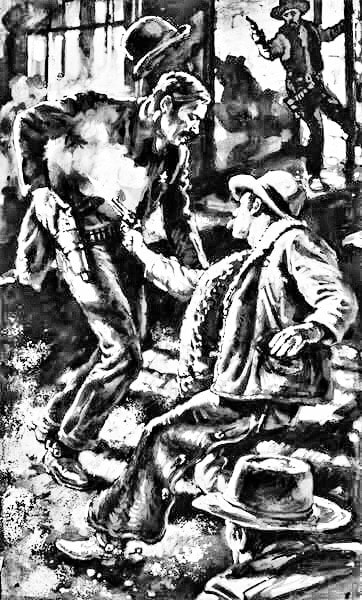
At ten o'clock last night, City Marshal Edward Masterson, discovered that a cowboy named Jack Wagner was carrying a six- shooter contrary to the City Ordinance. Wagner was at the time under the influence of liquor, but quietly gave up the pistol. The Marshal gave it to some of Wagner's friends for safe keeping and stepped out into the street. No sooner had he done so than Wagner ran out after him pulling another pistol, which the Marshal had not observed. The Marshal saw him coming and turned upon Wagner and grabbed hold of him.
CLICK HERE FOR SECOND STORY VERSION 
Wagner shot Marshal Masterson at once through the abdomen, being so close to him that the discharge set the Marshal's clothes on fire. Masterson then shot Wagner. About this time a man named Walker got mixed up in the fight. It appears he was a boss herder and Wagner was working under him. He also got shot once through the left lung, and his right arm Was twice broken.
 
Wagner, being shot ran into Peacock's saloon and fell upon the floor, where he remained until carried away by friends. He was fatally shot through the abdomen. He died on the evening of the 10th, and was buried on the hill near town (Boot Hill) at 4 P.M. on the eleventh.
 
Walker, the boss herder, ran through Peacock's saloon and fell some distance in the rear of the saloon from whence he was carried by his friends to a room over Wright Beverly & Co.'s store, where he now lies in a very precarious condition.
 
Marshal Masterson walked across the tracks and street and entering Hoover's saloon in the agonies of death he said to George Hinkle, "George, I am shot," and sank to the floor. His clothes were still on fire from the discharge of the pistol. He was carried to his brother's room where in half an hour he died.
 ​
Picture
Everyone in the City knew Ed Masterson and liked him. They liked him as a boy, they liked him as a man, and they liked him as an officer. The funeral procession marched to the military cemetery at Fort Dodge, where the last rites were performed.
 
Dodge City Times and Ford County Globe ​

The Mystery of the Final Resting Place

The story of Ed Masterson is deeply touching, especially when considering the uncertainty surrounding his final resting place. After his tragic and untimely passing, Ed was honored with a heartfelt funeral that reflected his dedicated service, complete with full military honors. For a time, he was laid to rest in the military cemetery at Fort Dodge, just a few miles southeast of Dodge City, Kansas—a serene location that honored many who valiantly served their country.
However, in the following years, several administrative decisions led to a troubling policy that sought to relocate non-military burials from the Fort Dodge cemetery. Amidst this upheaval, Ed Masterson's remains were transferred to Prairie Grove Cemetery, nestled just north of Dodge City. Sadly, as the management of the cemetery changed and Prairie Grove eventually closed its doors, his remains were likely moved once more, possibly to Maple Grove Cemetery, located west of Dodge City. This series of relocations, however, occurred without the proper record-keeping, leaving the exact location of his grave shrouded in mystery.
While the website FindAGrave lists Maple Grove Cemetery as his presumed burial site, it carries a significant note indicating that this designation is "supposed or disputed." As a result, Edward Masterson's true resting place remains an enigmatic and poignant mystery. This uncertainty adds a bittersweet layer to his legacy in the rich tapestry of the American West, especially when contrasted with the well-documented and widely visited grave of his brother, Bat Masterson, who rests peacefully in a cherished area of New York City.

The Legacy of a Dodge City Marshal

Edward John Masterson's life, though tragically cut short, offers poignant insights into the realities faced by law enforcement on the Kansas frontier. Born in Quebec and journeying west with his family, he experienced the very essence of frontier life, engaging in buffalo hunting and railroading before stepping into a crucial role as a peace officer in Dodge City. Appointed Assistant Marshal in June 1877 and promoted to City Marshal by December of that same year, he earned deep respect for his effectiveness, courage, and unwavering dedication to his duties. His bravery was evident during the Shaw shooting incident, and his staunch commitment to upholding the town's vital gun ordinance ultimately led to his untimely death on April 9, 1878.
Masterson's contribution occurred during a chaotic time in Dodge City, embodying the spirit of lawmen striving to bring order amidst the tumult of the cattle trade era. His death was not just a heartbreaking loss for his family; it resonated throughout the community, marking a significant moment in Dodge City's history and prompting a shift in law enforcement leadership. While his individual legacy may often be overshadowed by that of his brother Bat, whose longer and more varied life nurtured greater fame, Ed's story is essential to understanding the Masterson family's collective impact on Dodge City.
His sacrifice serves as a heartfelt reminder of the inherent dangers faced by those who donned the badge on the frontier, reflecting the complex tapestry of duty, violence, and family loyalty that defined the era. Edward Masterson deserves recognition not merely as the brother of a Western icon but as a dedicated lawman who served his community with honor and ultimately made the ultimate sacrifice in the challenging streets of Dodge City. His story invites us to remember him not just for his tragic end but for his commitment and courage throughout his life.

Home

Picture

About

Menu

Contact

Follow @wildwestpodcas1
Copyright © 2015
  • Home
    • Menu >
      • Books >
        • Dime Novel
        • Buffalo Days
        • Indian Wars
        • Man in a Black Derby Hat
        • Return of the Great Hunters
        • Luke McGlue
        • Free Audio Book
      • Wild West Podcast
      • Boot Hill Museum
      • Boot Hill Gunfighters' >
        • How to Become A Gunfighter
        • Roles
        • Scenario
        • Reenactments
        • Fights
        • Big Gunfight
    • Whiskey & Westerns on Wednesdays
    • Gunsmoke
  • Fort Dodge
    • Fort Dodge Buildings
    • Fort Dodge History >
      • Fort Dodge 1865
      • Fort Dodge 1866
      • Permanent Post 1867
      • Henry Douglas 1867
      • Richard Irving Dodge 1872
  • Dodge City
    • Saloons & Varieties
    • Time Line
    • Buffalo Days >
      • Adobe Walls >
        • William Bill Tilghman
        • Billy Dixon
        • Dave Morrow
        • Tom Nixon
        • Charles Rath
        • HooDoo Brown Story
        • Emanuel Dubbs Story
    • Cattle Drives >
      • Cattle Town
      • Gambling
      • Scarlet Ladies
    • Dodge City War
    • Soule Canal
    • Bull Fight of 1884
    • Rodeo History
    • Legends >
      • Wild Bill Hickok
      • Charles Bassett
      • James Masterson
      • Ham Bell
      • Bat Masterson
      • Chief Spotted Tail
      • George M. Hoover
      • Chalkley Beeson
      • Ormond W. Wright
      • Dora Hand
      • Webster
      • Luke McGlue
      • Ed Masterson
    • Saloon War
    • Mexican Village
  • Indian Wars
    • Cheyenne
    • Battle Solomon Fork
    • Hancocks' War 1867
    • Beecher Island
    • Medicine Lodge 1867
    • California Joe
    • Trails to the Washita
    • Cheyenne Exodus
  • Kansas History
    • Santa Fe Trail
    • Overland Trail
    • Forts Mann & Atkinson
    • Civil War
    • Black Sunday
    • Outlaws >
      • Vigilantes
      • Famous Gunfights >
        • Battle of Cimarron
      • Guns of the West
      • Dave Mathers
      • William L Brooks
      • Texas Billy Thompson
  • Blog